
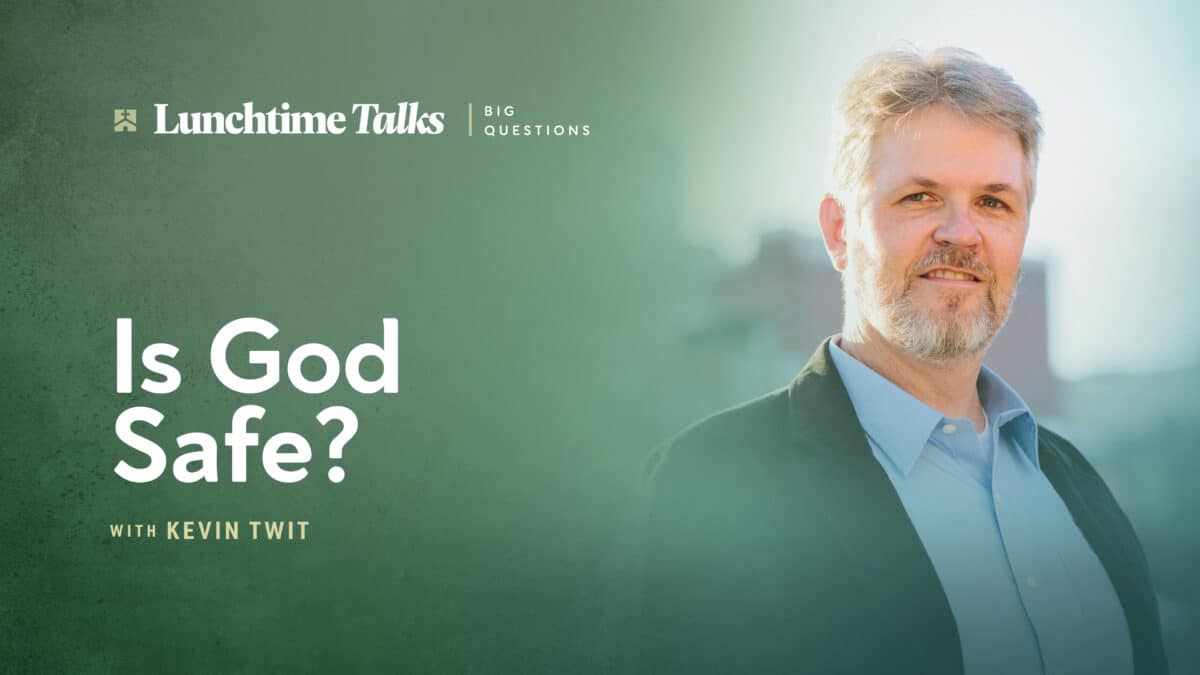
Is God Safe?
1. There are two interrelated questions here, as I see it. “Is God trustworthy?” and if He is, “Can I actually trust Him?” As it turns out, I think God has taken it upon Himself to meet both of these barriers.
2. Defeater beliefs – a belief (often seen as common sense) that, if believed, renders other truth claims not even worth considering. There are both philosophical and personal aspects to each of them; every culture has them, and often different culture-based doubt generators (Tim Keller’s helpful phrase) contradict another culture’s defeater beliefs. G.K. Chesterton explores this in a brilliant chapter called The Paradoxes of Christianity in his book “Orthodoxy.”
3. When we come to the question of trusting God, it is worth examining the question and, in particular, pondering where it might come from. I think there are several possibilities:
-
- It might arise from a philosophical bent demanding certainty before trust can be given. I would point out that, as philosopher Michael Polanyi argued (and Esther Meek in her more popular take on Polanyi’s approach in “Longing To Know”), all knowledge is ultimately based on faith. Keller said it this way, “You can’t doubt everything all at once. You have to stand somewhere to doubt. And where you are standing is based on faith.” Esther explains that one of the challenges in coming to know God in our day is mistaken ideas about what knowing actually is. Knowing God is more like knowing a person than knowing a math formula. Even after almost 30 years of marriage, I can be somewhat confident in what my wife might think about something – but can I have certainty? So, trust is built as we get to know someone, as their character is revealed over time and our experience with them. (Newbigin’s book “Proper Confidence” is very helpful on this.)
- It might arise from the place where we are standing. So often our questions conceal presuppositions that should be brought to the surface and examined. This is not easy to do – especially if we surround ourselves with people who think like us. C.S. Lewis, in his wonderful essay, God In The Dock, explains the way modern people have turned upside down their assumptions about who needs to answer to whom. Modern people believe God is in the dock (where the defendant sits in a British courtroom, and the onus is on Him to defend Himself and His ways in the world.
- But more likely, the difficulty in trusting God comes from the life we have experienced and from the things we see all around us. So what can we say to that? As John Frame said once, if we come to the Bible looking for answers to the problem of pain and evil, the kinds of answers that will end all of our questions, you won’t find that. But if you come to the Bible looking for the kinds of answers that give us reason to trust in the midst of our pain and confusion, the Bible has a lot to say to help.
4. Isaiah 50 “Trusting God in the Dark” I love how in this passage God (through Isaiah, His prophet) does not shame them or deny what Israel feels – they feel divorced from God. But God encourages them to stay curious, and He gives a couple of reasons. The first is His character. He encourages them to take
seriously what they do know about who He is and what He has done. But He also encourages them to stay curious because the story is not over yet. And as the allusions to the cross that Paul picks up in Romans 8 show, no one could have predicted the surprising “rest of the story” that God would bring. I think that God wants our why questions to evolve into Who questions. But sometimes our why questions become like little eddy currents, and we get stuck swirling around. Surely knowing that God would send His Son one day to cry out “My God, why?!” as He suffered on a cross should help us not jump to quick conclusions about
why God is doing or allowing things to happen.
5. The cross is the ultimate reason to trust God in the dark. We have a God with scars who did not exempt Himself from pain, but took it intentionally. Edward Shillito (writing after WWI) captured these thoughts in his poem, Jesus of the Scars:
If we have never sought, we seek Thee now:
Thine eyes burn through the dark, our only stars;
We must have sight of thorn-pricks on Thy brow,
We must have Thee, O Jesus of the Scars.
The heavens frighten us; they are too calm;
In all the universe we have no place.
Our wounds are hurting us; where is the balm?
Lord Jesus, by Thy Scars, we claim Thy grace.
If, when the doors are shut, Thou drawest near,
Only reveal those hands, that side of Thine;
We know to-day what wounds are, have no fear,
Show us Thy Scars, we know the countersign.
The other gods were strong; but Thou wast weak;
They rode, but Thou didst stumble to a throne;
But to our wounds only God’s wounds can speak,
And not a god has wounds, but Thou alone.
6. Perhaps, rather than seeing the pain of our stories as a barrier to trust, perhaps we could see them as a doorway into deeper communion with Jesus. I found this true when I discovered this poem by poet and hymnwriter James Montgomery, Our Saviour’s Prayers in the stanzas describing the Garden of Gethsemane.
Next, with strong cries and bitter tears
Thrice hallow, d he that doleful ground
Where, trembling with mysterious fears,
His sweat like blood-drops fell around,
And being in an agony,
He prayed yet more earnestly.
Here oft in spirit let me kneel,
Share in the speechless griefs / see,
And while He felt what I should feel,
Feel all his power of love to me,
Break my hard heart, and grace supply
For him who died for me to die.
7. But ultimately, we need God to open our eyes to see Jesus as more beautiful and believable. Have you asked for His help? I believe, because God has made the good evidences convincing to me by the power of His Spirit. And thus we should ask for His help. We should be honest with ourselves if we actually want to trust God – maybe we need His help to want His help.
8. It is important that you find a helpful community as you struggle. For one thing, each of us has come to understand different aspects of the comfort of Jesus as the result of our different stories. What if we saw our stories as a kingdom resource to share where we have found Jesus faithful in our own lives? And yet we need an honest community that will not make us feel like we have to pretend that everything is just great. That’s why we have found the hymn by John Newton, I Asked The Lord That I Might Grow so helpful in RUF.